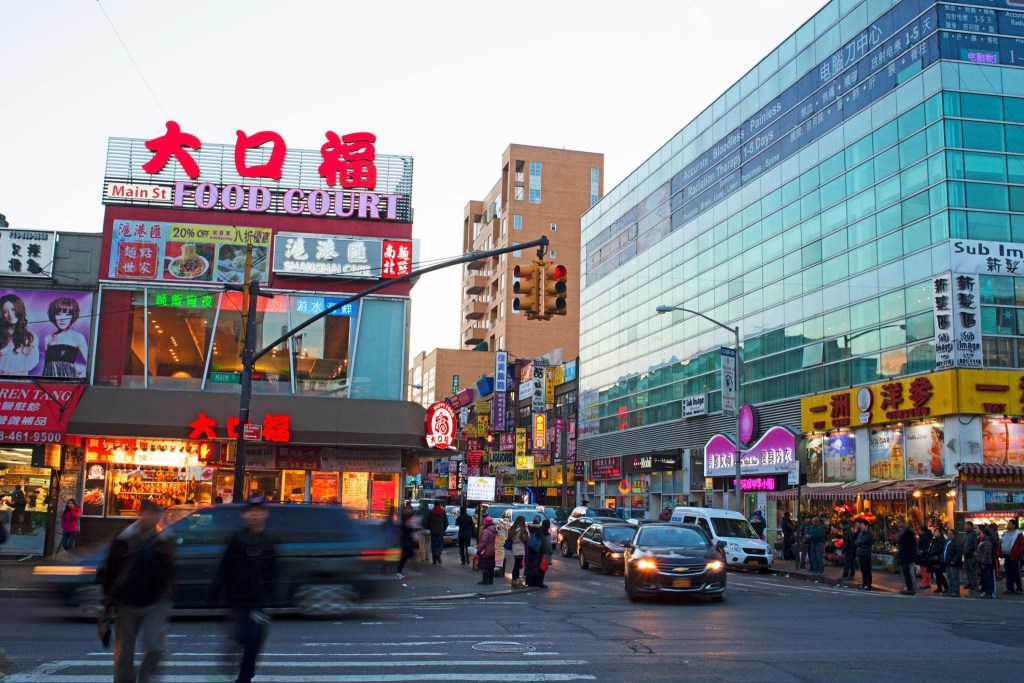
In Flushing, a new generation of Chinese-American wealth is turning community, culture and capital into something more powerful than luxury alone.
Everyone thinks New York’s future is being built in Manhattan.
I’m not so sure.
Walk through Flushing on a busy summer weekend and the evidence is difficult to ignore.
Families move through Main Street. Restaurants compete for attention. Entrepreneurs greet longtime customers. Young professionals move between generations and languages. Real-estate projects rise beside businesses that have served immigrant families for decades.
And then, almost quietly, millions of dollars change hands in property transactions.
One recent example: investors Lap Fung Sun and Ying Ying Lin acquired a Flushing industrial property for $15.5 million, a transaction involving a 25,500-square-foot building and additional development potential.
A few blocks away, the neighborhood’s annual street festival brought thousands of people into the commercial district, with more than 65 businesses and organizations participating.
One event was public.
The other was private.
But together, they reveal something larger.
Flushing is no longer simply a place where immigrants come to build a life. It is increasingly a place where culture, entrepreneurship, property and influence intersect.
And that may make it one of the most consequential neighborhoods in New York’s next chapter.
The Immigrant Neighborhood That Became an Economic Ecosystem
The first generation often had a straightforward definition of success.
Work hard.
Own something.
Educate the children.
Buy a home.
Save money.
Create opportunities that did not exist in the old country.
For many immigrant families, Flushing was never intended to be the final destination.
It was the launchpad.
A restaurant could become a family business.
A small store could become a property investment.
A modest apartment could become the first piece of a real-estate portfolio.
A child’s education could become the family’s greatest long-term asset.
But something happens after several decades of accumulation.
The children grow up.
They become physicians, lawyers, entrepreneurs, investors, architects, executives and technology professionals.
The family acquires not only money, but something harder to measure:
knowledge of how America works.
Then another generation arrives.
And suddenly the question changes.
It is no longer:
How do we get out?
It becomes:
What can we build here?
That is a fundamentally different stage of the immigrant story.
The New Definition of Chinese-American Wealth
Traditional wealth is easy to photograph.
A Manhattan penthouse.
A luxury automobile.
A private club.
A designer handbag.
A skyline view.
But generational wealth is increasingly about things that don’t photograph as easily.
Relationships.
Education.
Business ownership.
Real estate.
Cultural fluency.
Community trust.
Global networks.
And the ability to move comfortably between worlds.
For affluent Chinese-American families, this creates a distinctive advantage.
A person who understands American institutions, Chinese culture, immigrant entrepreneurship and global commerce is operating with a form of cultural capital that cannot simply be purchased.
That may become one of the defining assets of the next generation.
Identity itself can become an economic advantage.
Why the Festival Matters
The street festival may seem like the lighter side of the story.
Food.
Music.
Shopping.
Families.
Community organizations.
But look more closely.
More than 65 businesses and organizations participated.
Thousands of people attended.
Chinese regional cuisines were represented alongside businesses and services serving the broader community.
This is not simply entertainment.
It is economic infrastructure.
Every restaurant, retailer, professional practice and community organization contributes to a network.
That network creates trust.
Trust creates customers.
Customers support businesses.
Businesses generate income.
Income becomes investment capital.
Investment capital eventually shapes real estate.
And real estate reshapes the neighborhood.
Culture and capital are not separate systems.
They can reinforce one another.
That is what makes Flushing so interesting.
The $15.5 Million Question
The $15.5 million property acquisition deserves attention not because the number is impressive.
New York sees large transactions every day.
It matters because of what the property represents.
The building contains existing industrial space and additional development potential.
In other words, the buyer isn’t simply purchasing square footage.
They are purchasing optionality.
The future ability to determine what that piece of Queens becomes.
That is one of the most important characteristics of sophisticated wealth.
The wealthy don’t only buy what something is.
They buy what it could become.
That mindset is increasingly relevant in neighborhoods undergoing transformation.
Manhattan Has Prestige. Queens Has Something Else.
Manhattan’s advantage has historically been scarcity.
There are only so many Fifth Avenue addresses.
Only so many Central Park views.
Only so many landmark buildings.
Queens offers a different form of value.
Scale.
Space.
Entrepreneurial density.
Cultural diversity.
Family networks.
Transportation.
Development opportunity.
And perhaps most importantly:
room to grow.
This creates an intriguing possibility.
Maybe Flushing does not need to become Manhattan.
Maybe trying to become Manhattan would actually destroy part of what makes it valuable.
The future could belong to neighborhoods that develop their own definition of prestige.
Not exclusivity.
Influence.
The Luxury Question
This is where luxury brands should pay attention.
The next affluent Chinese-American consumer may not define luxury the way previous generations did.
Luxury may increasingly mean:
A restaurant where your family knows the owner.
A beautifully designed home near the businesses and people you trust.
A private educational network.
An unforgettable travel experience.
A piece of real estate with long-term potential.
A business your children can inherit.
A community where your cultural identity isn’t something you have to explain.
This is a quieter form of luxury.
It is less about announcing:
“I have arrived.”
And more about saying:
“I belong here.”
The Contrarian Truth
Here is the part most New York observers may miss.
The future of luxury may not be exclusivity. It may be belonging.
For decades, luxury marketing has been built around keeping people out.
Private access.
Limited editions.
Exclusive addresses.
Invitation-only experiences.
But affluent immigrant communities can produce a different kind of status.
The ability to move through multiple worlds.
The ability to connect generations.
The ability to speak multiple cultural languages.
The ability to create opportunities for people around you.
In that environment, influence becomes more valuable than visibility.
And community becomes a form of social capital.
But There Is a Tension
There is also a danger in romanticizing this transformation.
A neighborhood becoming more valuable does not automatically mean everyone becomes wealthier.
Rising property values can benefit owners while creating pressure for renters and small businesses.
Luxury development can create new amenities while changing the character of established communities.
Investment can generate opportunity while accelerating displacement.
That tension should remain at the center of the conversation.
The question should never simply be:
“Is Flushing getting richer?”
It should be:
“Who participates in the wealth Flushing is creating?”
That is the more difficult question.
And ultimately, the more important one.
The Children of Flushing
Perhaps the most fascinating characters in this story are not the investors.
They are their children.
Imagine a second-generation professional who grew up hearing stories about sacrifice.
Parents who worked long hours.
Grandparents who arrived with little.
A first business.
A first home.
A first investment.
Now that child has choices their parents never had.
They can work in Manhattan.
Move to California.
Start a technology company.
Become a physician.
Enter finance.
Build a global career.
Or come back.
That last option is perhaps the most interesting.
Because returning is no longer necessarily a retreat.
It can be a strategic decision.
The neighborhood your parents built may now contain opportunities that didn’t exist when they arrived.
The immigrant neighborhood can become the platform for the next generation’s ambition.
The New American Dream
Maybe the American Dream was never supposed to mean leaving your community behind.
Maybe it meant creating enough prosperity that the next generation could choose what to do with it.
That is a different vision of success.
Not:
“I escaped.”
But:
“I built something worth returning to.”
That distinction could define the next chapter of Chinese-American entrepreneurship.
What Flushing Could Become
The most interesting future for Flushing isn’t necessarily becoming New York’s next luxury district.
It could become something more complicated.
A global Chinese-American cultural center.
A business ecosystem.
A real-estate investment destination.
A culinary capital.
A professional-services hub.
A place where first-generation entrepreneurs meet third-generation investors.
A place where Chinese culture isn’t preserved behind glass but continuously reinvented.
A place where American identity and Chinese identity aren’t competing identities.
They are complementary ones.
That is potentially a much more powerful form of cultural influence.
The Question for Investors
Investors should ask:
What happens when cultural loyalty becomes an economic asset?
A neighborhood with strong community ties can generate remarkable resilience.
People don’t simply consume there.
They establish businesses there.
They raise families there.
They invest there.
They send their children to schools nearby.
They return to restaurants for decades.
They recommend professionals to one another.
They build social networks.
Those relationships can create economic value that doesn’t always appear on a spreadsheet.
Until it does.
The Question for Luxury Brands
Luxury companies should stop asking:
“Where do wealthy Chinese consumers shop?”
And start asking:
“Where are wealthy Chinese-American consumers building their lives?”
Those are different questions.
One identifies consumers.
The other identifies ecosystems.
And ecosystems are where the next generation of influence is created.
The Question for the Next Generation
Perhaps the most important question belongs to the young people growing up in Queens.
Your parents may have measured success through sacrifice.
Your grandparents may have measured it through survival.
You may measure it differently.
Maybe success is freedom.
Maybe it is entrepreneurship.
Maybe it is experiences.
Maybe it is time with family.
Maybe it is owning a business.
Maybe it is creating something meaningful.
Or perhaps it is having enough financial independence that you can decide where you belong.
There is no single definition.
And that may be the point.
The New Queens
The story of Flushing is ultimately not a story about a neighborhood becoming wealthy.
It is about a neighborhood becoming confident in its own identity.
The old hierarchy said:
Manhattan was where influence lived.
Queens was where people came from.
The emerging reality may be very different.
Queens can be where influence is created.
That is why the $15.5 million property transaction matters.
That is why thousands of people gathering for a street festival matters.
That is why immigrant restaurants matter.
That is why family businesses matter.
That is why young professionals returning to Queens matter.
These are not disconnected stories.
They are pieces of a larger transformation.
Why This Story Deserves More Attention Than Today’s Biggest New York Lifestyle Headline
Because the biggest headline tells us what is happening today.
Flushing may be telling us what New York looks like next.
The next generation of wealth may not be defined by the address on a business card.
It may be defined by the strength of the network behind it.
The next generation of luxury may not be defined by exclusivity.
It may be defined by belonging.
The next generation of Chinese-American success may not be defined by assimilation.
It may be defined by cultural fluency.
And the next generation of Queens may not be defined by becoming Manhattan.
It may be defined by becoming Queens—more confident, more connected, more prosperous and more influential on its own terms.
The most important transformation may therefore be happening quietly.
Not in the skyline.
Not in a luxury advertisement.
Not in a celebrity’s Instagram post.
But in the decisions of families who are asking a profound question:
What can we build here that our children will inherit?
That may be the real story of Flushing.
And perhaps the beginning of the New Queens.
#Flushing #QueensNYC #NewYorkCity #ChineseAmerican #ChineseAmericanWealth #AsianAmerican #AsianAmericanWealth #GenerationalWealth #ImmigrantEntrepreneurship #RealEstate #QueensRealEstate #NewYorkRealEstate #LuxuryLifestyle #LuxuryRealEstate #CulturalCapital #CommunityWealth #WealthCreation #Entrepreneurship #FamilyBusiness #AsianEntrepreneurs #ChineseEntrepreneurs #NextGenerationWealth #NewQueens #NYCLuxury #NewYorkLifestyle #CulturalIdentity #SocialCapital #CommunityBuilding #UrbanDevelopment #FutureOfNewYork #QueensBusiness #FlushingNYC #MainStreetFlushing #NYCRealEstate #LuxuryMarket #AffluentCommunities #GlobalWealth #AmericanDream #GenerationalSuccess


Leave a Reply