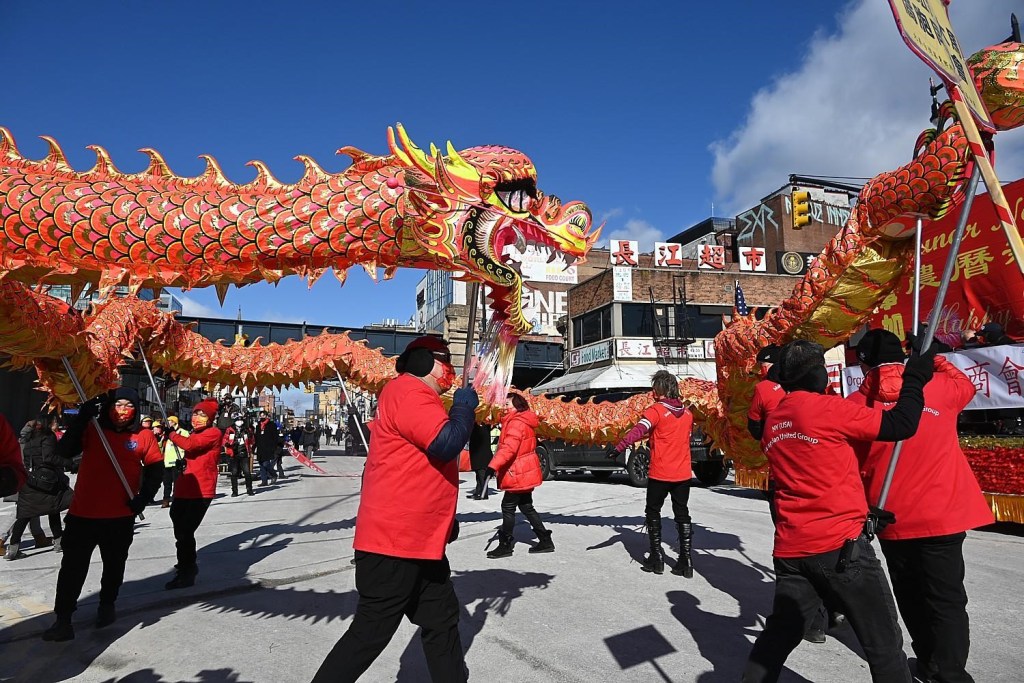
Flushing is no longer simply preserving Chinese culture. It is redesigning what Chinese-American life looks like.
FLUSHING, QUEENS — On September 19, Kissena Boulevard will become a stage for something that looks, at first glance, like a familiar neighborhood celebration.
Nearly 50 vendors are expected to gather between Main Street and Sanford Avenue for a Mid-Autumn festival offering food, clothing, consumer products and community services. There will be Chinese dance, hip-hop, jazz and live music.
It is easy to call this another Flushing street festival.
It is harder—and more interesting—to see what it represents.
Because the most consequential transformation taking place in Chinese America may not be happening inside a luxury tower or a Manhattan restaurant.
It may be happening on the street.
And it may be happening in the minds of a younger generation.
The Neighborhood Is Changing. So Is the Definition of Success.
For the first generation of many immigrant families, success had a fairly clear vocabulary.
Work hard.
Buy property.
Build a business.
Send the children to good schools.
Create financial security.
Then, if possible, pass something on.
The next generation has inherited those ambitions but appears increasingly interested in something beyond accumulation.
What does success mean if you don’t have to choose between your heritage and your future?
That question is visible throughout Flushing.
Traditional Chinese culture exists alongside contemporary American life. Family businesses operate alongside sophisticated professional services. Mandarin and English share the same sidewalks. Food, fashion, education, finance, health and entertainment increasingly overlap.
And the younger generation isn’t necessarily treating these combinations as contradictions.
They are treating them as normal.
That is a profound cultural shift.
From Preservation to Reinvention
The Mid-Autumn celebration scheduled for Kissena Boulevard is revealing precisely because its programming refuses to stay inside one cultural category.
Chinese dance will share the stage with hip-hop.
Jazz will sit alongside traditional celebration.
Food and fashion will coexist with health, transportation and lifestyle information.
This is not simply cultural preservation.
It is cultural remixing.
And remixing is often what happens when a culture becomes confident enough to stop worrying about whether it is authentic.
The first generation asks:
How do we preserve what we brought with us?
The second asks:
How do we combine it with what we learned here?
The third may simply ask:
Why can’t it be both?
That is where identity becomes an asset.
Cultural Capital Is Becoming Real Capital
For years, discussions about Chinese-American wealth have focused on familiar indicators: homeownership, business ownership, professional achievement, education and investment.
Those remain important.
But another form of wealth is becoming increasingly visible.
Cultural capital.
The ability to move comfortably between worlds has practical value.
A young entrepreneur who understands both American business culture and Chinese family networks possesses one kind of advantage.
A real-estate professional who understands the aspirations of immigrant families possesses another.
A luxury brand that understands why a second-generation customer may want both a global product and a connection to heritage possesses another.
And a neighborhood that can provide all of those connections in one place becomes more than a commercial district.
It becomes an ecosystem.
That is what makes Flushing worth watching.
Queens Doesn’t Need Manhattan’s Permission
For decades, Manhattan served as New York’s shorthand for arrival.
The address mattered.
The restaurant mattered.
The institution mattered.
The neighborhood communicated status before a person said a word.
But something more complicated is emerging in Queens.
Flushing does not need to become another Manhattan.
Its advantage may be precisely that it has developed a different model of influence.
Manhattan has traditionally organized luxury around exclusivity.
Flushing is increasingly demonstrating the economic power of belonging.
That distinction matters.
A luxury experience can be expensive.
But cultural belonging cannot simply be purchased.
It has to be earned, inherited, shared and experienced.
And increasingly, affluent consumers appear to understand the difference.
The Children Are the Story
The most important people at a cultural festival may not be the sponsors, vendors or organizers.
They may be the children standing nearby.
They are the ones watching what their parents built.
They are the ones deciding which traditions survive.
They are also the ones deciding which traditions change.
For immigrant families that accumulated wealth during the past several decades, this creates a fascinating generational transition.
The parents may have spent their lives building financial capital.
Their children are being asked to inherit something larger:
financial capital + cultural capital + social capital + global identity.
That combination could become one of the defining characteristics of affluent Chinese-American life in the decades ahead.
A Different Kind of Luxury
Luxury has traditionally been about having what other people cannot have.
The next generation may increasingly define it differently.
Having access to experiences that feel meaningful.
Knowing where a dish came from.
Understanding the story behind a craft.
Being able to speak another language.
Having grandparents who remember another country.
Growing up between cultures.
Knowing a neighborhood deeply enough to understand its people rather than simply visiting its most expensive restaurants.
In that sense, the most valuable thing Flushing offers may not be something that can be placed on a balance sheet.
It is context.
And context is becoming increasingly rare in a globalized city.
The Contrarian View
Here is the part most people miss:
Queens may not be following Manhattan’s trajectory. Manhattan may eventually be following Queens’.
That sounds backwards.
But consider the forces shaping the next generation of urban luxury.
Consumers want authenticity.
Brands want cultural relevance.
Investors want growing communities.
Young professionals want connectivity.
Immigrant families want opportunity without erasure.
And global travelers increasingly seek neighborhoods where multiple cultures have collided long enough to create something genuinely new.
Flushing has been doing that for decades.
The rest of New York may only now be recognizing its value.
From Chinese Neighborhood to Global Platform
This is why the Mid-Autumn market deserves more attention than its modest scale might suggest.
It isn’t simply about mooncakes, performances or shopping.
It is a snapshot of a community becoming more comfortable with its own complexity.
A Chinese-American neighborhood can celebrate an ancient festival while embracing contemporary music.
A family business can coexist with modern entrepreneurship.
A child can inherit tradition without being trapped by it.
And a community can remain culturally distinctive while becoming increasingly global.
That isn’t assimilation.
It is evolution.
The Bigger Question for Queens
The question facing Flushing isn’t whether it will become wealthier.
The more interesting question is:
What kind of wealth will it create?
Will the next generation simply inherit property?
Or will it inherit networks?
Will it inherit businesses?
Or will it build brands?
Will it inherit traditions?
Or will it turn those traditions into new forms of art, design, hospitality, fashion and entrepreneurship?
Will it leave Queens to find success elsewhere?
Or will success increasingly come back to Queens because that is where the cultural infrastructure already exists?
Those questions extend far beyond one Mid-Autumn festival.
They point toward the future of the borough itself.
The Future May Already Be Here
There is a tendency to look for the future of New York in glass towers, venture-capital announcements and luxury openings.
Sometimes the future is much quieter.
It is a teenager performing a traditional dance without embarrassment.
A second-generation entrepreneur opening a business that combines two cultures.
A family buying its second property.
A parent teaching a child Mandarin.
A young professional deciding to build a career in the neighborhood where her grandparents first arrived.
A street festival where Chinese dance, jazz and hip-hop occupy the same stage.
These moments rarely make the biggest headlines.
But together, they reveal something important.
The future of Chinese-American success may not be about choosing between cultures.
It may be about becoming fluent in both—and then creating something neither could have produced alone.
That may be the real transformation underway in Flushing.
And perhaps the real luxury of the next generation will not be having more than everyone else.
It will be belonging to more than one world.
Why This Story Deserves More Attention Than Today’s Biggest New York Lifestyle Headline
New York’s luxury press naturally gravitates toward the spectacular: a famous address, a $200 tasting menu, a new designer boutique, another record-setting apartment.
Those stories tell us what is expensive.
They do not always tell us what is valuable.
The quieter story unfolding in Flushing may be more consequential.
Because wealth is moving through generations.
Identity is becoming more confident.
Culture is becoming commercially powerful.
And Queens is increasingly becoming the place where these forces meet.
Manhattan has long represented established wealth.
Queens may represent what wealth becomes next.
That is the story worth watching.
• Explore More In-Depth Perspectives & Unique Insights
• Watch our latest stories and in-depth content on YouTube
• Listen to our podcasts on Spotify
• Follow the latest discussions and trends on X
• Join our Facebook community and connect with others
• Discover more stories, inspiration, and the latest updates on Instagram
• Follow us on TikTok for behind-the-scenes stories and engaging short-form videos
#QueensNYC #FlushingNYC #ChineseAmerican #AsianAmericanSuccess #GenerationalWealth #FutureOfLuxury #CulturalCapital #QueensRising #NYCRealEstate #ImmigrantSuccessStory #FamilyBusiness #WealthCreation #FutureCities #ChineseEntrepreneurs #LuxuryLifestyle #NextGenerationLeadership #NewYorkFuture
 纽约皇后区新闻 Queens NYC News
Leave a comment